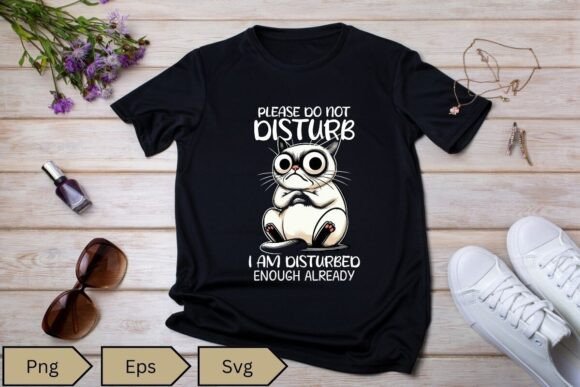
PLEASE DO NOT DISTURB I AM DISTURBED Graphics
As a brand designer who’s helped over 200 local businesses refine their visual identity—from neighborhood coffee roasters to handmade soap studios—I opened PLEASE DO NOT DISTURB I AM DISTURBED Svg expecting a meme-style novelty. What I found instead was a surprisingly versatile graphic design asset with real small business branding potential—if used intentionally.
The first impression is bold, unapologetic, and warmly irreverent: a stylized angry cat paired with layered typography that balances sarcasm and charm. It reads as playful but not childish, modern but not sterile, humorous but not chaotic. For a local business—say, a specialty coffee shop launching a “No Meetings Before 10am” limited-edition cold brew line—it lands perfectly: confident, relatable, and memorable. It feels handmade-adjacent without sacrificing polish, and it carries the kind of personality that builds instant emotional connection with customers scrolling Instagram or browsing a boutique shelf.
Where This Graphic Design Asset Earns Its Keep in Real Local Business Projects
I recently applied PLEASE DO NOT DISTURB I AM DISTURBED Svg to packaging mockups for a women-owned candle brand launching a “Quiet Hour” collection (soothing lavender + bergamot scents meant for intentional downtime). Used as a subtle foil stamp on kraft paper labels and as a decorative border on thank-you cards, it elevated the entire unboxing experience—not by shouting, but by whispering shared understanding.
Here’s where this SVG truly shines:
- Product labels and hang tags: Its clean vector structure scales beautifully from 1.5-inch sticker size to full-label coverage, maintaining legibility and expressive weight.
- Promotional banners and social media graphics: The high-contrast composition works instantly at thumbnail size—ideal for Facebook ads or Instagram Story highlights targeting cat-loving, coffee-fueled small business audiences.
- Printable inserts and seasonal campaign visuals: As a recurring motif across holiday gift boxes or “Self-Care Saturday” flyers, it reinforces brand voice without repeating the same phrase verbatim.
- Product mockups and web design assets: The transparent background and editable layers make it easy to drop into Canva templates, Shopify banners, or Etsy listing previews—no clipping required.
- Boutique visuals and local event signage: Paired with warm neutrals and a friendly sans serif, it adds wit to chalkboard menus or window decals without undermining professionalism.
How It Strengthens Core Brand Presentation Goals
This isn’t just clipart—it’s a functional piece of brand identity infrastructure. When thoughtfully integrated, PLEASE DO NOT DISTURB I AM DISTURBED Svg supports measurable business outcomes:
- Stronger first impression: On crowded shelves or saturated feeds, its expressive tone cuts through noise faster than generic floral or minimalist motifs.
- Better product recognition: Repeating the cat motif across packaging, stickers, and digital ads creates visual consistency that builds recall—even before customers read the name.
- Clearer visual hierarchy: Its balanced negative space and typographic rhythm naturally guide the eye, making it ideal for pairing with essential info like flavor names or care instructions.
- More consistent brand identity: Unlike trend-driven fonts or filters, this illustration holds up across print, web, and physical touchpoints—especially when anchored to a thoughtful color palette.
- Improved customer trust: Humor done well signals authenticity. Customers sense when a brand knows itself—and isn’t trying too hard.
Where to Use It With Intention—And Where to Pause
This SVG excels in contexts where personality matters most: product mockups for Etsy sellers, decorative accents on artisanal food labels, hero graphics for small-batch skincare launches, or playful banners for local pop-up markets. It works especially well beside handwritten fonts (for handmade businesses) or clean sans serifs (for modern cafés).
But proceed with care in these scenarios:
- Formal corporate branding: Not suited for law firms, medical practices, or B2B SaaS—its energy clashes with expectations of authority and restraint.
- Ingredient-heavy or regulatory packaging: Avoid placing it near mandatory text (e.g., allergen statements or net weight), where visual competition could reduce readability or compliance clarity.
- Luxury minimalist brands: If your aesthetic leans into quiet elegance (think matte black ceramics or linen apothecary labels), this graphic may feel tonally dissonant.
- Low-contrast backgrounds: Test thoroughly on light grays or cream kraft—some versions of the SVG rely on crisp black/white contrast to retain impact.
Practical Brand Designer Notes You’ll Want to Apply Today
Before finalizing any use of PLEASE DO NOT DISTURB I AM DISTURBED Svg, run these quick checks:
- Test it on real packaging mockups—not just screen previews—to assess scale, spacing, and emotional resonance in context.
- Convert to grayscale and preview on small labels: Does the cat silhouette remain distinct? Does the phrase stay legible at 8pt?
- Layer it beside your brand’s primary typefaces—serif, sans serif, script, and display—to confirm harmony, not competition.
- Verify commercial licensing: Confirm it permits use on physical products (like T-Shirt Designs), resale packaging, and client-facing marketing visuals.
- Inspect SVG editability: Can you isolate the cat, text, and coffee cup elements? That flexibility matters for customizing color fills or repositioning components.
- Check PNG transparency: Ensure no stray pixels or anti-aliasing halos compromise clean edges on dark or textured backgrounds.
- Compare against competitor packaging: Does it stand out meaningfully—or blend into a sea of similar “cat + coffee” tropes?
Used with strategy—not just convenience—PLEASE DO NOT DISTURBED I AM DISTURBED Svg becomes more than a T-Shirt Designs download. It becomes part of your brand’s visual vocabulary: a wink, a sigh, a shared moment of humanity in a world that moves too fast. And for local businesses building loyalty one genuine interaction at a time, that kind of resonance isn’t just nice to have—it’s essential.